
budgetwithelly · Challenge · coupon · coupons · family · Family Share · free · frugal · mom · motherhood

Tips and Tricks to Improve Your Financial Life #BudgetWithElly

7106f1b2fe4c5b1a15cc563eb70f602b

By improving our financial lives, we also increased our happiness, in general. For this reason, I find important to share some tips and tricks that really works (at least for me).

I’m almost in the best moment of my financial life. because of the steps of Dave Ramsey. Also because we know how to handle money, not having debts, by saving and investing as much as we can.

Here are some tips and tricks that works for us (doesn’t necessarily work for everyone). Share what your tips in savings are in the comments!

#1. Use money

Rather than buying things with credit or debit cards, use cash for everyday expenses like eating out, fuel or supermarket.

Spending money makes the spending more real, and you still have the advantage of knowing exactly when the money runs out, avoiding spending more than you have.

#2. Stay home

Often going out makes you more likely to spend unnecessarily. Eating at  restaurants, going shopping, stoping at convenience stores for snacks. It is hard to avoid spending when you’re on the street.

Instead, stay home and find ways to entertain without spending. It is also a great way to be with your family.

# 3. Keep a “list of the 30 days”

If you often buy on impulse something that absolutely is not a need, go put it on the “list of the 30 days.”

You can not buy anything beyond what is necessary – anything beyond that goes to the list, with the date it was registered.

After thirty days, you can buy – but, most often, the anxiety to buy has passed, and you can evaluate the actual need more calmly.

# 4. Do exercises

Staying healthy is the best way to avoid medical expenses in the future.

# 5. Often talk to your partner

It is important that you and your partner are financially aligned. You should have the same financial goals, and from there on you must share the same spending plan and policy to avoid impulse purchases.

Make sure you both know what the monthly expenses are, how is the bank balance, among other things. A simple weekly conversation of 20 minutes is enough.

Communication is essential.
6271faa303b440de5e1f94675903a835

# 6. Record all income and expenses

There are expensive software like Microsoft Money, Quicken, etc., which can do wonders to your financial information. There are also some that are free to both desktop and online, they also do the same things.

The problem is that I do not need it all. All I need is a way to track my money easily, no hustle, and the ability to access that data virtually, so that I can update them from anywhere.

An excellent way to really use is Google Drive (formerly Google Docs and Spreadsheets), who use Gmail. But nothing prevents you to use a financial spreadsheet or even a notebook.

The important thing is to maintain that record. And do it in the simplest way possible.

# 7. Work out at home

Some may disagree with this tip, and thats no problem. You should do what ever way that works for you. But I saved enough money (over US $ 1000 per year), who used to spend on gyms and changed for walking at a park near my home.

All though we don’t all have a gym in our homes, it’s still cheaper to buy some weights to work out at home, or even practice walking / running somewhere nearby. An academy is honestly not necessary.

# 8. Cancel your cable TV

I’m not saying you should stop watching TV – I even watch movies and football games regularly, for example.

The difference is that I’m sure I’m watching something I really want, instead of useless programs we see on TV most of the time.

In addition, there are enough online content, free and good quality.

# 9. Donate, lend and borrow

Get rid of excess things in your home, you not only make your life much simpler and quiet, but also will become much harder to buy things that will just lay around again.

Once your home is organized (and simplified), you will not want to go back.

Also, donate books, clothes and toys you no longer need. If you need something (a book, for example), send e-mail to your friends or post on Facebook asking if anyone has it. There is the chance of someone close by having it and give it to you for free if they don’t use it anymore.

# 10. Find happiness in life, not on spending

Often, people buy things because they think (perhaps unconsciously) that this will bring happiness. “I have to have those clothes or buy that car,” some think. So they buy what they want it to be, and are happy only for a few days.

Then they need to buy more. And it becomes a no yes cycle.

Instead, learn to value life. Find fun in the people around you. In doing something you really love. In exercising.

There is so much in life that make us happy, it is not necessary to try to find happiness in spending.


budgetwithelly · coupon · coupons · family · Family Share · free · frugal · mom · motherhood · savings

7 ideas to learn how to #BudgetWithElly

a186e3dbe550edf7fb8d7c2417f7a84b

As the family grows,  your cost will increase, and you will always seems to have something new that will come up.

It’s easy to lose track. Here are some tips on how to save money for a greatter achievements in life: the house, the car, the trip, a special gift, a smooth retirement …

1. Record all your expenses for a month To be able to save, you need to know how you are spending the money. It sounds simple and obvious, but it isn’t. Over the next month, mark all your expenses. You don’t need a complicated spreadsheet. A little notebook will do. Write all small expenses, such as  tips or just that cup of coffee. Get ready for some surprises. That sacred coffee every day, or a daily bottle of water, may represent more than $90 per month, or $1080 per year (and $ 10,800 in ten years! Considerable savings). And the outfit you got for your child, those cute ones you cannot resist? If paid with a credit card, calculate an increase of 20+ percent, at least on top of the sticker price. It’s what it will cost you if you fail to pay the invoice total that month. You do not need to give up your daily dose of coffee, or hydration, or fail to dress your child in super cute clothes. All you have to do is just weigh in all the spending. A bottle of water can come full from home, for example. As for the clothes, wait for sales or clarence  and give yourself a spending limit whenever you start buying. Knowing where the money goes every month, you will have a better idea of ​​where to cut to save for the future.

2. Put yourself first. It may not make much sense at first, but the secret to start saving is to “pay” first. No, it’s not for you to buy the first blouse you see on display.  Think about a realistic amount of long-term goals (like changing the car, make that treatment, saving for emergencies, a vacation), and then “pay” early in the month, separating the money in another account. If you wait until the end of the month to see how much left to save after all mandatory expenses, you will realize that there is nothing left, because it is almost always the case for everyone.
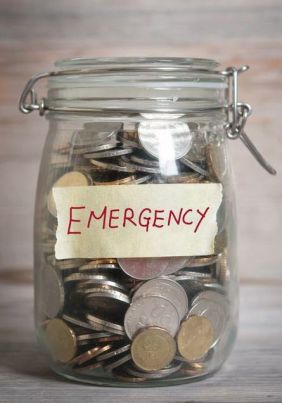
The best way to make payments is to schedule automatic transfers from your bank account to another account or an investment. That way it will make you save. You can create, for example, two accounts: one for a long-term goal, such as saving for retirement or emergencies, and one for your dream closest consumption (the trip, the car etc.). Set the transfer to close the day you receive the salary. The cool thing is to create a routine, as if it was as mandatory as paying the electric bill. Later in the month, you will have the satisfaction of knowing that a portion of the salary is already saved for something really constructive. Economists say that an emergency fund should have the equivalent of six months of total expenses. If you have managed to gather that amount, you may even start saving for retirement.

3. Pay off your debts Yes, paying your debts is the best way to save money. The interest rate charged on overdrafts or credit card is much higher than the profit of any investment. Get rid of your debts first, especially credit card, so you can start saving money. If you have late payments, contact the company or bank to see if you can negotiate a settlement. Do not wait, untill you have all the money to pay off the debt. Find out how to pay it off  as soon as possible, even if it has to be little by little.
If it is for you to have some debt, let it be to finance a home. Yes this is a debt that is worth it.
For the car payment, you can do the following: when you finally finish paying, instead of rushing to exchange model and pick up a new provision, pretend that the booklet is not over. Continue paying the same amount for a time, only for yourself, in a separate account. So you will earn enough money to make a better deal, giving greater input and achieving a lower performance, with less interest.

4. Take one goal at a time and be strong! Choose an object of desire, something you want very much. It may be a new sofa, an electronic device, a trip. Calculate how much it will cost and trace a realistic goal, like saving for six or twelve months to achieve. To motivate, spread photos and advertisements of this desired item everywhere (at work, at home, within the portfolio). Whenever thinking about buying something, ask yourself if you want it as much as you want your big goal, the one for which you are saving.

33a64b1dfffe4407f4ad0205c70bf690

5. Make the withdrawals hard Search for alternatives applications that are not ready or available to move. Funds with automatic withdrawals when the current account is negative doesn’t work – it is very easy to end up with no savings in a moment of excitement or necessity. Make separate accounts, or apply in investment rules which do not allow automatic withdrawals, or that deem certain work redemptions (such as CDs).

6. Did you receive a money did not expect? Save it! You received a refund of income tax, a bonus at work or some unexpected money? First, resist with all their might to spend that’s the first impulse. If you can resist for a few days, it’ll be much easier to appreciate the extra money. If you’re still having some debt, use that money to reduce it (pay the most from the car financing or own home, for example). All Credit card debts have priority! Second comes the overdraft. It won’t cost you anything to try and talk to the bank manager to see if there’s an easier way to pay. If you do not have a debt, save the money in that special account different from the day to day account, for something that really matter.

7. Rethink the spendings with a car If you have a car, write down all the expenses you have with it. Say that car is practically a child, and it’s true. From property taxes, insurance, financing, fuel, parking, tolls, licensing, washing and repairs, you may be surprised at the amount of expenses annually.
There are people who realize that life becomes even easier without the car (or just one car for couples). Even if for you the car is essential, take it easy with the spending. Leave the car at home whenever you can. Walk to the supermarket and use the delivery service at home. To concentrate their business in the same region. Take the car to solve several things at once, And do the math. In large cities is more expensive to park a car than going back and forth in a taxi, depending on distance. And spending on toll and fuel can surpass that amount of a bus ticket – and even plane.

2694a1650e2567b7286cb358ebc0af20

Friday · Health · mom · motherhood

How #HealthyFriday can help you prevent the future

IMG_1566

Did you know these facts

Blood clots can occur in both the veins and the arteries. A clot formed in a vein could restrict the return of blood to the heart, causing pain and swelling as blood gathers behind the clot. Clotting in the arteries typically happens when they harden, and a deposit of plaque narrows the inside of the arteries. As the passage narrows, the heart needs to force blood through the opening, and that strong pressure can rupture the plaque. The body then overcompensates by forming an unnecessary clot in the artery, which can lead to heart attack and stroke.

Smoking is one of the most prominent risk factors for developing blood clots, as well as other heart problems and some chronic diseases. Stop the habit by using nicotine patches and gums, prescription medications, and support groups. Other risk factors for blood clots include obesity, pregnancy, immobility, certain cancers, trauma, age, and family history of blood clots.

Clot

Actually, doctors recommend exercise to prevent blood clots. The Department of Health and Human Services recommends that adults get 150 minutes a week of moderate aerobic activity, which can be swimming, walking, dancing, and biking, among others.

Symptoms can be experienced in five places.

1. Heart—chest pain, shortness of breath, chest heaviness.

2. Brain—weakness of the face, difficulty speaking, vision problems, severe headache, dizziness.

3. Arm or leg—swelling, tenderness and warmth on limb, sudden or gradual pain.

4. Lung—racing heart, sharp chest pain, shortness of breath, coughing up blood.

5. Abdomen—severe abdominal pain, vomiting, diarrhea.

DVT most often forms deep in the blood vessels in your leg. This can partially or completely block flow of blood to the heart and damage one-way valves in your veins. About 350,000 Americans are diagnosed with DVT each year, and many more don’t know they have it.

Even healthy, young individuals can develop DVT. As you age, your risk becomes slightly higher, but many patients with it are in their twenties and thirties. Pregnant women are at an increased risk of developing DVT until around six weeks after they give birth.

If you are diagnosed with a blood clot in your vein, your doctor may refer you to a hematologist, a doctor who specializes in blood diseases. If you have a blood clot in your artery, you may have several different doctors involved in your care, such as a cardiologist, neurologist, and hematologist.

Your doctor may prescribe anticoagulants, which prevent clots from forming, and thrombolytic, which dissolve blood clots. You also may undergo catheter-directed thrombolysis, a procedure in which a catheter is inserted into the body and guided to the blood clot, delivering clot-dissolving medication inside of it. You may also have a thrombectomy in which your blood clot is surgically removed.

surviver

In reality, blood clots are often preventable. To reduce your risk, live a healthy lifestyle, check your blood pressure at least once a year, and talk to your doctor if you have a family history of blood clots.

I'm a Surviver DVT & PE
I’m a Surviver
DVT & PE
dad · family · fatherhood · kids · mom · motherhood

4 ways to have a Family Saturday

We all have busy lives. Finding time today is almost impossible

If you’re like me, you feel like there’s still stuff to do at the end of the day. Tempted to keep your computer and phone on at all times. Fighting distractions in your brain even when with your family.

You need to have priorities. In the end, our family is all that matters, so don’t push your family to the bottom of your to-do list.
If you want a stronger marriage and family, start by investing more time.

https://twitter.com/4Guys_1Girl
Family Date Night

1. Remember that “Date Night” doesn’t have to happen at night

Look for ways to connect during the day.

2. Never walk into your house while you’re on your phone

I make sure to end the call before walking through the door.

3. Have set times where everybody is unplugged

Try to shut down the electronics more often. Talking with each other is always better than texting with somebody else!

https://twitter.com/4Guys_1Girl

4. Prioritize family time AND one-on-one time

Plan activities you can all do as a family, also plan for one-on-one time with each other and with each of your kids individually. That time will be golden for your kids.

https://twitter.com/4Guys_1Girl